back to the blog
Guide 1: How To Prepare For CBT Training

James B · April 10, 2026
Whether you're about to book your CBT or your training day is just around the corner, a little preparation goes a long way. Here's everything you need to know before you arrive.
Am I Eligible For CBT?
Before anything else, make sure you meet the basic requirements.
You must be at least 16 to ride a moped (up to 50cc) on a CBT, or 17 to ride a motorcycle (up to 125cc). You'll also need a valid UK provisional or full driving licence. Without one, you won't be able to train. If you don't have a provisional licence yet, here's how to apply for one.
EU licence holders will need to bring a returned D9 form alongside their EU photocard. Make sure you've applied for and received this before the day.
Lay Out What You'll Need To Bring
- Your valid UK provisional or full driving licence (the photocard)
- EU licence holders: your returned D9 form and EU photocard
- If you're bringing your own motorcycle: valid insurance (check your policy covers training), MOT certificate, road tax, and L plates
That's it. Your training school handles the rest.
Plan What You'll Wear
What you wear on the day matters, both for your safety and because your instructor can refuse to train you if you're not dressed appropriately for motorcycle training.

Jacket and trousers. Thick, abrasion-resistant materials such as leather or heavy denim are what you need. Avoid ripped jeans and anything lightweight like cotton or nylon. Motorcycle-specific jackets and trousers are ideal if you have them.
Boots. Sturdy, ankle-covering footwear is required. Leather motorcycle boots are best, but solid work boots or hiking boots will usually do. Trainers, plimsolls, or anything without ankle support won't be allowed.
Weather-appropriate layers. CBT is largely an outdoor course. In cold conditions, wear thermals underneath your jacket. In warm weather, stick to materials that still offer protection, such as Kevlar-lined riding jeans. Shorts are not permitted.
Helmet, gloves and hi-vis. Most training schools provide a helmet, gloves, and a high-visibility vest. If you want to bring your own, they must meet BSI, CE, or ECE standards. Check your booking confirmation for what's included at your school.
How To Prepare In The Days Before
Study the Highway Code. You don't need to memorise it, but a solid understanding of road signs, speed limits, and right of way rules will make the theory portions of your CBT much easier. The Highway Code is lays this all out and is well worth reading Our Guide 3: Road Signs is also a good starting point.
Get some time on a bicycle. If you can, get out on a bike in the days before your CBT. Riding in live traffic on two wheels will help you build the spatial awareness and road confidence that transfers directly to motorcycling. It's one of the most practical things you can do to prepare.
Get familiar with motorcycle controls. You've never ridden before and that's fine, it's what the CBT is for. But familiarising yourself with the basic layout of a motorcycle (throttle, brakes, clutch, indicators) before you arrive means you'll spend less mental energy on day one. Guide 2: Motorcycle Controls covers everything you need to know.
Understand the 5 elements. The CBT is not a pass or fail test. It's a structured training day with five elements you need to complete to the instructor's satisfaction. Knowing what's coming helps you relax and focus on learning. Read The 5 Parts of a CBT for a full breakdown.
Watch some CBT training videos. YouTube has plenty of footage of real CBT training days. Watching one gives you a feel for the pace, the off-road exercises, and what on-road riding looks like for a complete beginner.
Get a good night's sleep. The CBT is a long day, typically seven to eight hours. You'll be concentrating hard throughout. Arriving well rested makes a real difference.
On The Day
Arrive early. We can't stress this enough! Missing the start of your CBT is against DVSA regulations and you won't be allowed to train, which means money wasted. Look up the exact location of your training school in advance as some are on industrial estates or have obscure entrances. Don't rely on phone signal on the morning, and don't assume the journey will go to plan.
Double-check your booking confirmation the evening before, including the date, time, and location. If anything looks wrong, contact us before the day.
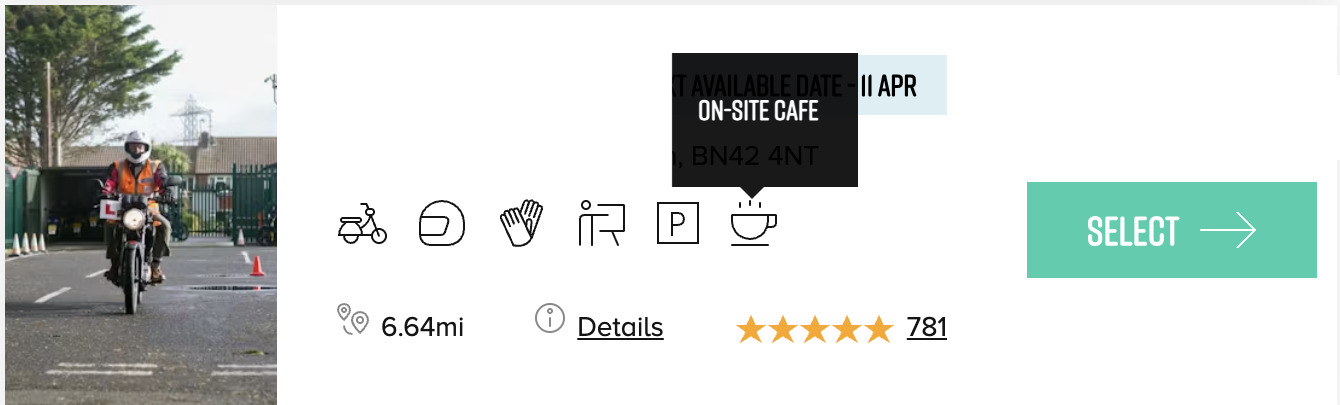
Plan your lunch. The CBT day includes a break, so it's worth checking Google Maps beforehand for a supermarket or cafe near your training school. A packed lunch is always a reliable option too, if you prefer. Some training sites have an on-site cafe, which is worth knowing about if you're relying on a hot drink to keep you going through the afternoon.
The eyesight check. Your CBT will begin with an eyesight check. You'll need to read a standard number plate from 20 metres away. If you normally wear glasses or contact lenses, bring them. If you're at all unsure about your eyesight, it's worth getting it checked before your training day.
The riding elements. A significant portion of the day is spent on a motorcycle, first off-road in a controlled environment, then on public roads with your instructor. By the end, you'll need to demonstrate that you can ride safely and with awareness. It's not about perfection. It's about showing you've taken on what you've been taught.
What If You Don't Complete On The Day?
Not everyone gets through all five elements on their first attempt, and that's completely fine! It doesn't mean motorcycling isn't for you. It just means you need a little more supervised time on the bike, or that the road rules need a bit more revision before things click. Your instructor will give you honest feedback on what to focus on, and you can book again when you feel ready. You can even
What Happens After CBT?
Once you've completed your CBT, you'll receive a certificate (DL196) that allows you to ride a motorcycle or moped up to 125cc on public roads for two years. After that, you can either renew your CBT or progress to a full motorcycle licence.
NEXT: Guide 2: Motorcycle Controls
Not on the road yet? Find your nearest CBT instructor.
FIND NEAREST CBT