back to the blog
What Are the Advantages and Disadvantages of a Motorcycle?

Olivia C · February 26, 2026
You’ve seen it happen. You’re trapped in a soul-crushing traffic jam when a motorcycle calmly glides past the stationary line of cars. For a second, you wonder: what is that actually like? Is it real freedom, or is the danger as serious as people warn?
This is the practical breakdown of what it means to choose life on two wheels: the tangible upsides that can genuinely improve your day-to-day life, and the sobering downsides you can’t afford to ignore.
The Advantages of Motorcycling
1) You defeat traffic (and reclaim your time)
For many riders, this is the single greatest benefit: traffic stops owning your life.
In the UK, filtering (lane splitting) is legal in many situations, which means you can move through congestion rather than sit in it. Done properly, filtering can be safe and efficient, improving your journey time and helping overall traffic flow.
On a typical 30-minute rush-hour commute, a motorcycle can be dramatically faster than a car. That can add up to hours saved every single week: time you get back for yourself.
2) Parking becomes a superpower
Parking in busy places can go from stressful to effortless.
Motorcycles fit into smaller spaces: dedicated motorcycle bays, the “forgotten corners” of car parks, and those odd end-of-row areas that cars can’t use. Instead of circling the block, you can pull in, park, and walk away, often with lower parking costs too.
3) It can be cheaper than running a car
For many people, the cost equation is a major reason to ride.
- Upfront cost: A reliable new bike can often cost far less than a new car (commuter-capable bikes are commonly in the £4,000–£8,000 range).
- Fuel economy: Many motorcycles return strong MPG compared with cars.
- Insurance: Often cheaper, though it varies a lot by age, location, riding history, and bike type.
- Maintenance: Sometimes more frequent, but parts and labour can be less costly depending on the bike.
For a typical commuter setup, running costs can be meaningfully lower for motorcycles than cars.
4) You’re actually “there” on the journey
A motorcycle doesn’t just get you from A to B, it changes how you experience travel.
You smell fresh-cut grass. You feel the temperature drop as you pass through a shaded stretch of road. And because riding requires attention, it can pull you into a focused state that feels like active meditation.
One study (funded by Harley-Davidson and conducted by UCLA researchers) reported reduced stress-related biomarkers after riding, which matches what many riders describe: a short ride can reset your head after a rough day.
5) The unspoken ‘motorbike club’
There’s a subtle social bonus most people don’t expect.
A nod at the lights. Riders who pull over when they see someone stopped on the roadside. A shared identity that can feel grounding in an increasingly isolated world. You don’t have to don leathers and join a club to feel it, it’s often just baked into riding culture.
The Disadvantages of Motorcycling
1) The risks are real, and unavoidable
Let’s be direct: safety is the biggest drawback.
Motorcyclists have far less physical protection than car occupants, there’s no steel cage, no airbags, and no seatbelts. Your primary defences are gear, training, judgement, and constant awareness.
Crash statistics are stark. DfT statistics show that In Great Britain (year ending June 2025), motorcyclists made up 23% of road fatalities, despite accounting for under 1% of all motor traffic.
Even without debating exact numbers by country and year, the reality remains: riding carries higher risk compared to driving, and it demands respect.
A painful truth many riders live by is this: you must always assume other road users may not see you. The phrase you’ll hear too often after a collision is: “I didn’t even see them.”
2) You’re at the mercy of the weather
In a car, rain is an inconvenience. On a motorcycle, it can be miserable and potentially hazardous.
- Rain reduces traction and visibility.
- Wind can push you around and tire you out.
- Cold isn’t just uncomfortable; it can reduce dexterity and reaction time.
You’re fully exposed to the elements, and that affects both comfort and safety.
3) It’s more physically demanding and less practical
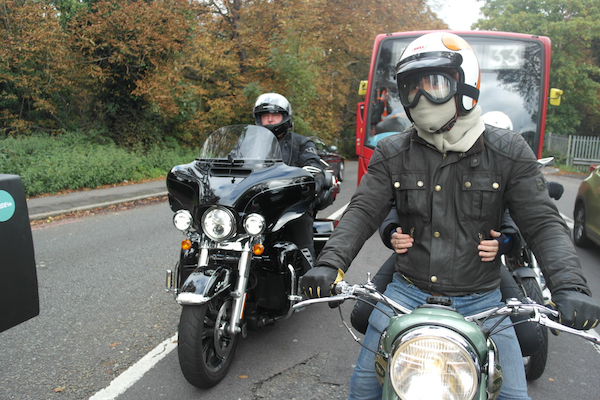
It may look like they’re just sitting down, but riding takes physical effort!
Wind pressure at speed is a constant force. Your core stabilises you. Your body absorbs vibration. Long distances can be tiring in a way car drivers don’t always understand.
Then there’s the gear routine: helmet, jacket, gloves, boots — every trip. It’s worth it, but it can feel like a chore when you’re just popping out for five minutes.
And practicality can be limited:
- Weekly grocery shop? Tricky without luggage.
- Giving a mate and a suitcase a lift? Not happening.
- Storage is minimal, so everything must be secured carefully.
4) Barriers to entry: licensing and learning curve
Getting started isn’t as simple as buying a bike.
You’ll need the correct licence/entitlement, and learning to ride takes practice. The clutch-throttle-brake balance at low speeds is a skill that feels awkward at first, and the early days can be mentally exhausting.
Training is essential, but it is also a hurdle of time, money, and commitment.
Interested in learning to ride? We offer motorcycle training from CBT training, all the way to full licence training, throughout the UK.
What Nobody Tells You (The First 6 Months)
You will probably drop your bike
For many new riders, the first drop isn’t a ‘crash’, it’s just slow, awkward, and embarrassing. A foot slips at a stop. The bike leans. Suddenly it’s on the ground and your heart is pounding while you hope nobody saw.
Your cheeks might burn… but it’s also a common rite of passage.
Then, one day, it clicks
In the beginning, riding is a running checklist:
Clutch in. Select gear. Smooth release. Add throttle. Balance. Check mirrors. Breathe.
Then one day you pull away from a junction and realise you did it all without consciously thinking. Shifting starts to feel natural. Your mental bandwidth returns and you can focus more on reading the road and riding smoothly. That’s when the fun really starts!
Gear isn’t just for safety, it’s for energy and comfort
Protective kit matters a lot in a slide, but it also prevents fatigue.
A good jacket blocks wind and cold. Proper gloves reduce vibration and stop numb hands. Comfort keeps you sharp, and sharp means you are safer.
Hesitation can be dangerous
One of the most important mindset shifts is decisiveness. Wobbling mid-corner or second-guessing a line can destabilise the bike.
You learn to assess, choose, and commit, and to look where you want to go, because the bike tends to follow your eyes. If you fixate on a pothole, you will drift towards it. If you look through the turn, you will ride through cleanly.
So, Is Motorcycling Worth It?
Choosing to ride a motorcycle over any other form of transport is a trade-off.
You’re swapping the passive comfort of a car for heightened engagement, and higher consequences if things go wrong. The highs can be incredible: the perfect corner on a crisp autumn day, slicing through traffic, arriving with your head clearer than when you left.
But the lows are serious. They demand training, proper kit, and ongoing respect for the road.
If the drawbacks feel like manageable challenges and the rewards still appeal, the best next step isn’t buying a bike: iIt’s trying it out safely, under the supervision of a DVSA-certified instructor.
The safest way to start (UK)
In the UK, a CBT (Compulsory Basic Training) course lets you learn in a controlled setting with experienced instructors on a bike that isn’t yours. It’s the easiest way to find out if riding suits you, without spending thousands on a motorcycle first.